

Gwangjang Market Food Guide (2026): What to Eat, Opening Hours and How to Order
October 23, 2026 | by Korea Bestie
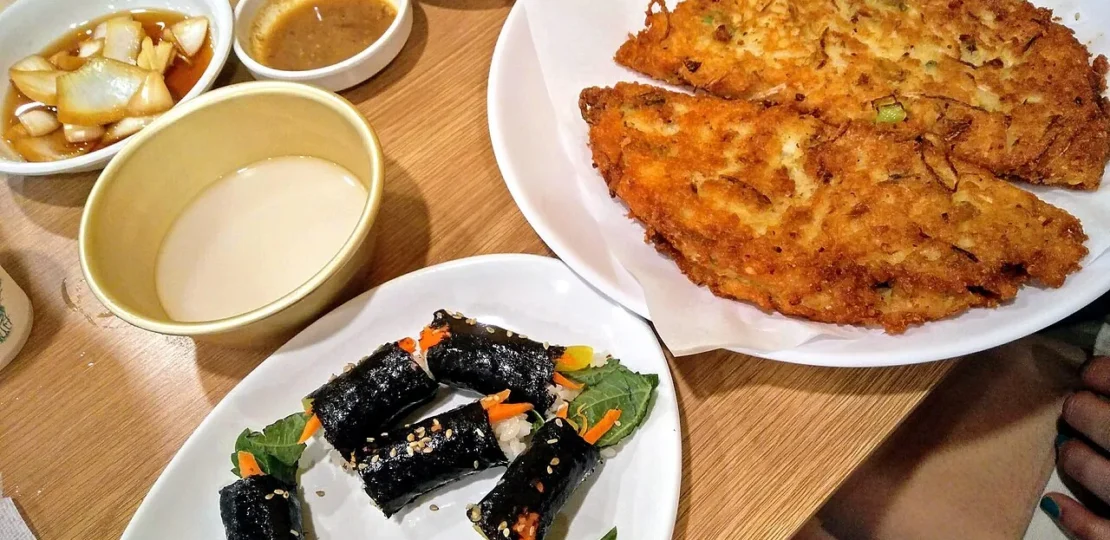
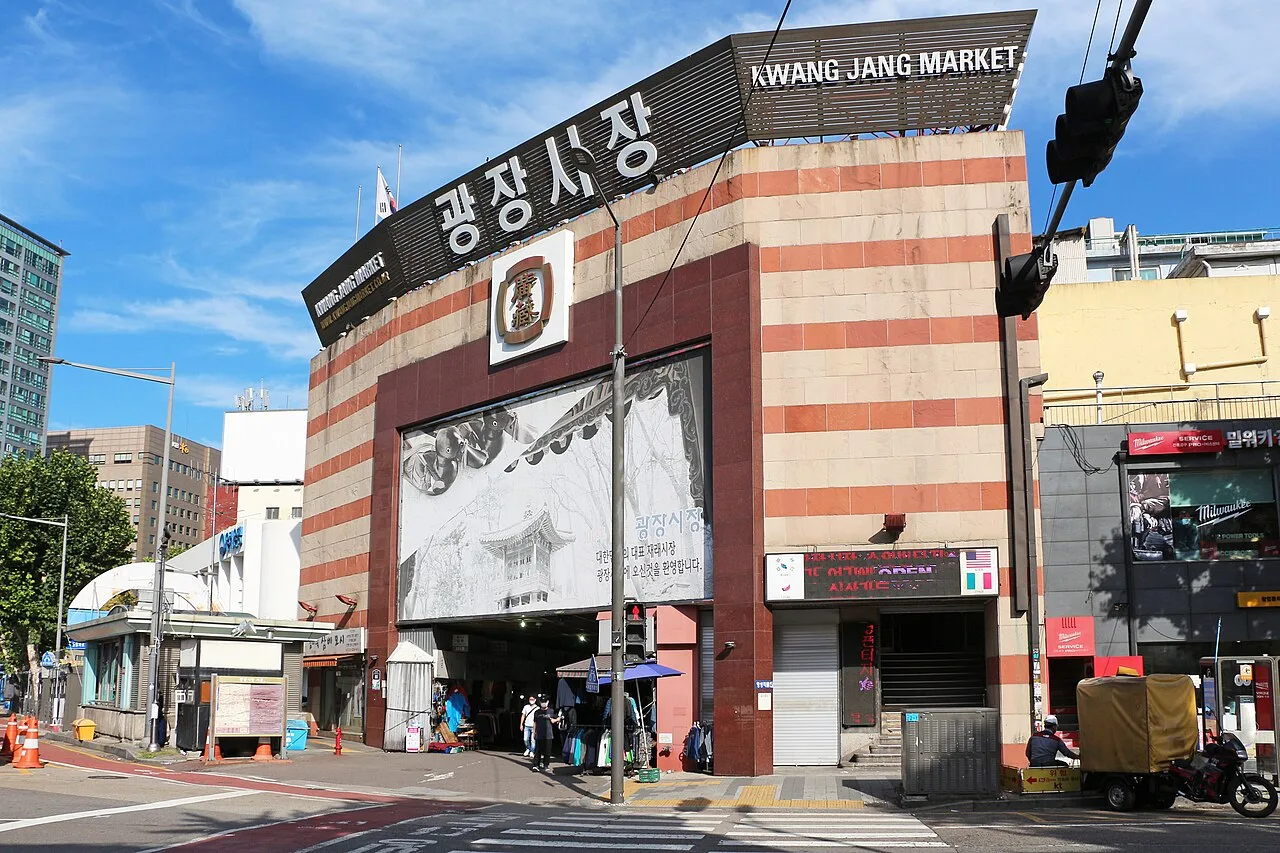
Gwangjang Market (광장시장) is Seoul’s most famous food market: a covered crossroads of stalls frying mung bean pancakes, rolling tiny “addictive” gimbap and serving raw beef yukhoe, where you sit on a heated bench elbow to elbow with locals. It opened in 1905 and is one of the oldest markets in Korea. Here’s what to eat, what it costs in 2026, and how to order without speaking Korean.
Last checked: October 2026. Prices vary by stall and change often. Dollar figures use about 1,330 KRW = 1 USD (October 2026).
This guide contains affiliate links. If you book through them, we may earn a small commission at no extra cost to you. Affiliate disclosure.
Quick answer
- When is it open? Food stalls run roughly 9:00–23:00 daily; the fabric and goods shops close around 18:00, and many close on Sundays.
- Which exit? Jongno 5-ga Station (Line 1), Exit 8, leads straight to the food alley.
- What to eat first? Bindaetteok (mung bean pancake, about 5,000 KRW), mayak gimbap (about 4,000 KRW a plate) and yukhoe (raw beef).
- Cash or card? Bring cash: many open-air stalls are cash only; the sit-down bindaetteok and yukhoe shops usually take cards.
- Budget? About 15,000–25,000 KRW (~$11–19) per person for a filling snack crawl.
First time in Korea? Start here: our step-by-step guide from landing to your first day.
What should you eat at Gwangjang Market?
| Dish | What it is | Rough price (2026) |
|---|---|---|
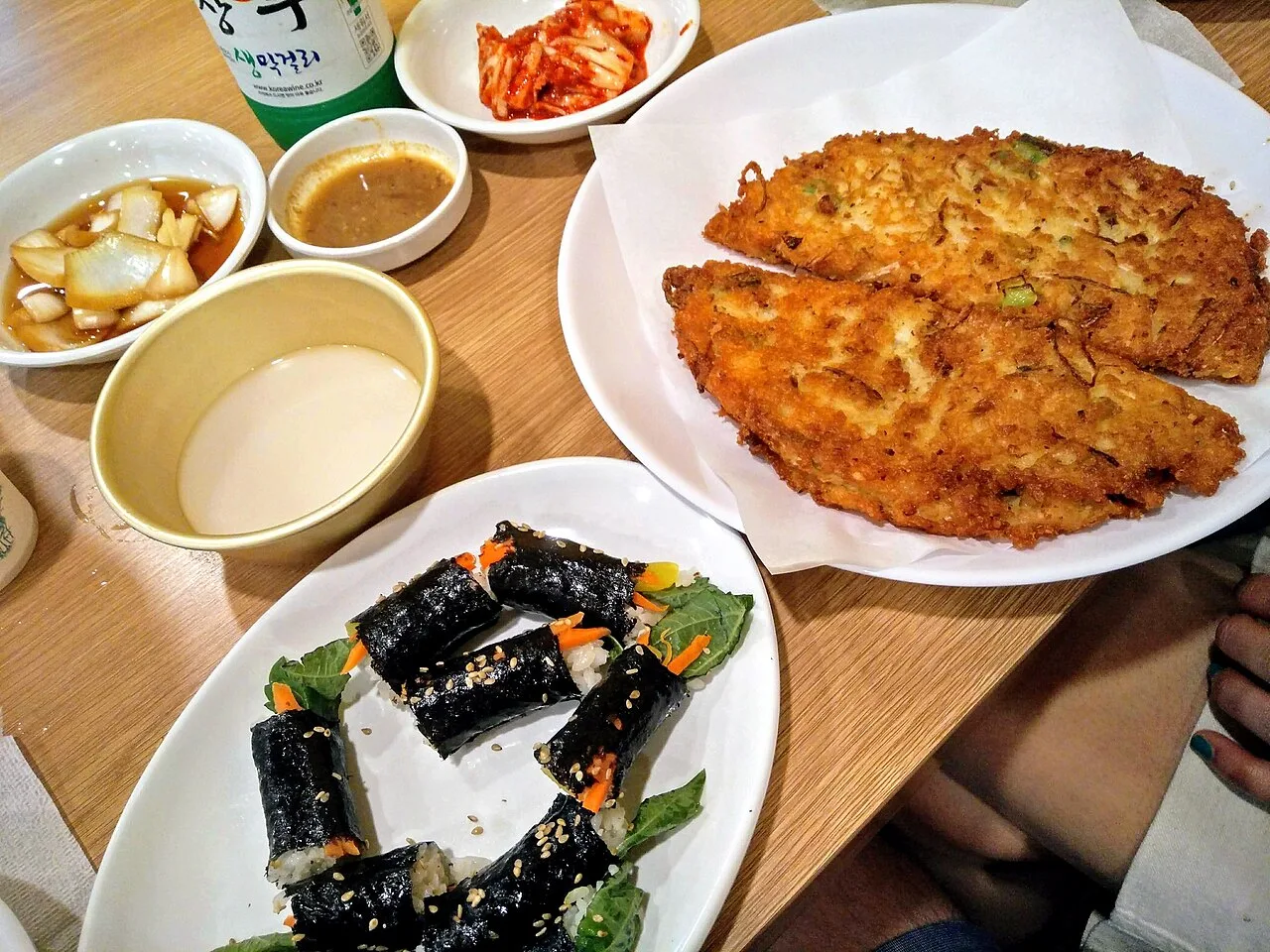
| Bindaetteok (빈대떡) | Crispy mung bean pancake, ground and fried to order | ~5,000 KRW (~$3.76) |
| Mayak gimbap (마약김밥) | Mini rice rolls with mustard-soy dip | ~4,000 KRW a plate |
| Yukhoe (육회) | Seasoned raw beef with pear and egg yolk | ~15,000–25,000 KRW a plate |
| Kalguksu (칼국수) | Knife-cut noodles in anchovy broth | ~7,000 KRW |
| Sundae (순대) | Korean blood sausage | ~8,000 KRW |
| Kkwabaegi (꽈배기) | Twisted sugar doughnut | ~1,000 KRW |
| Makgeolli | Milky rice wine to go with pancakes | ~4,000–5,000 KRW a bottle |
Bindaetteok at Sunhee-ne (순희네빈대떡)
The most famous pancake stall: watch the mung beans being ground on the spot, then fried in a pool of oil until the edges crackle. One pancake is enough for two to share as a starter. It’s a sit-down shop with tables, and takes cards.
Yukhoe at Buchon Yukhoe (부촌육회)
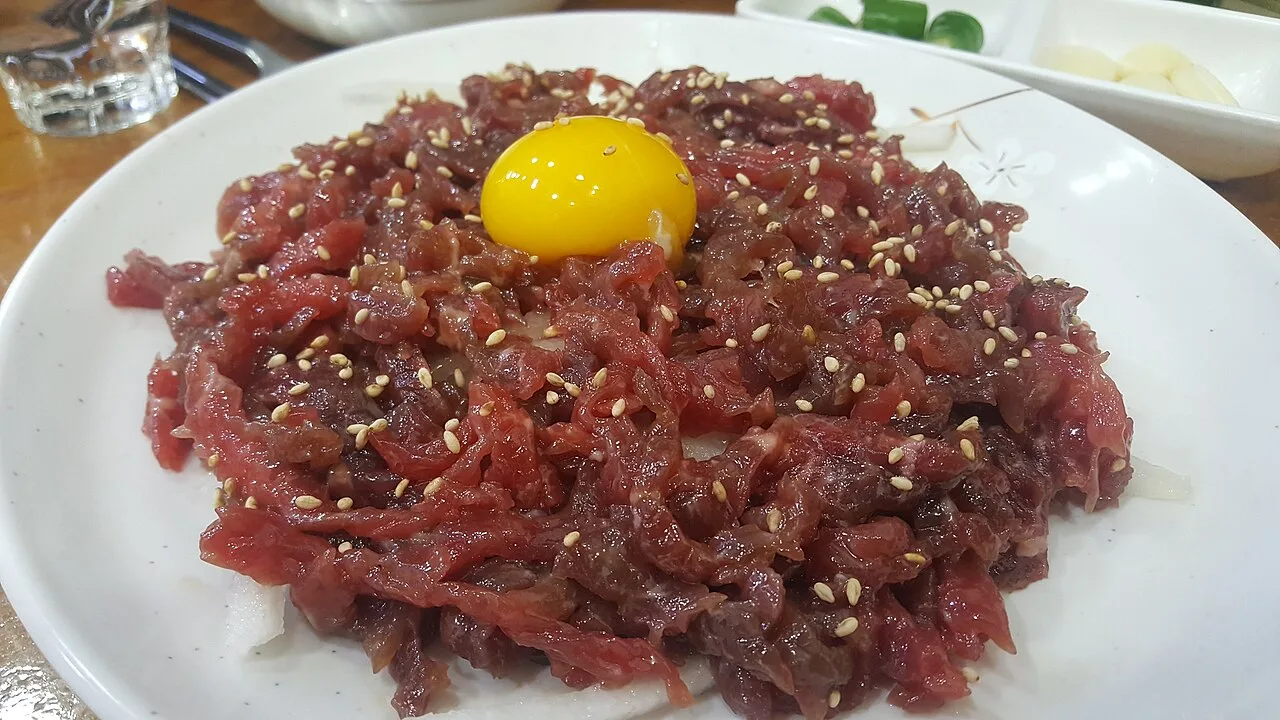
Gwangjang’s “yukhoe alley” is lined with raw beef restaurants, and Buchon Yukhoe has been listed by the Michelin Guide Seoul as a Bib Gourmand for years. Weekend waits can reach 45 minutes. Yukhoe is raw beef, so skip it if you’re pregnant or have a sensitive stomach.
The Netflix kalguksu stall
The kalguksu stall featured on Netflix’s Street Food: Asia (2019) still draws long queues. Neighbouring noodle stalls serve very similar bowls at the same price with little or no wait, so if the line is long, sit down at the next one.
When is Gwangjang Market open, and when should you go?
- Food stalls: from around 8–9 am until about 10–11 pm, every day. Some stalls take Mondays or certain Sundays off.
- Fabric, hanbok and goods shops (upstairs and in the side halls): roughly 9:00–18:00, and many close on Sundays.
- Best times: around 10–11 am for short queues and fresh griddles, or 15:00–17:00 between lunch and dinner. 18:00–20:00 is the peak.
- Arrive before 21:30. Popular stalls can sell out late in the evening.
How do you order at the stalls?
- Pick a stall with a free spot on the bench and sit down; there’s no separate queue system at most open stalls.
- Point at the food and show the number with your fingers. Many stalls now have picture menus or English signs.
- Pay when the food arrives or when you leave, as the vendor indicates.
- Don’t linger when people are waiting. Eat, pay and move on to the next stall.
Cash or card at Gwangjang Market?
- Bring cash in 1,000 and 10,000 won notes. Many open-air stalls (gimbap, noodles) are cash only.
- Sit-down restaurants such as the bindaetteok and yukhoe shops usually accept foreign cards.
- T-money is generally not accepted at the stalls. See money in Korea for ATMs that take foreign cards.
- Prices are posted at most stalls. Check before you order, especially for market-price seafood.
How to get to Gwangjang Market
- Jongno 5-ga Station (Line 1), Exit 8: the closest entrance to the food alley. Euljiro 4-ga Station (Lines 2, 5) is about 5 minutes south.
- From Insadong or Ikseon-dong it’s a 10–15 minute walk east along Jongno (Ikseon-dong guide).
- Carrying bags? Use the lockers at Jongno 5-ga Station first (Seoul luggage storage).
Map — Gwangjang Market: Google Maps · Naver Map (Naver Map is still the most reliable app for walking, bus and subway directions in Korea)
Good to know for foreign visitors
- Vegetarian: bindaetteok is mostly vegetarian but often contains pork or kimchi; ask for the plain version. Mayak gimbap usually contains no meat.
- Halal: none of the stalls are halal-certified; oil and grills are shared.
- Restrooms inside the market are basic. Use the subway station’s first.
- Accessibility: the main alleys are flat but crowded; benches are fixed stools without backs.
Rather go with a local? (Klook)
- Gwangjang Market food tours: a guide orders for you and explains each dish; most include several tastings. Check the group size and meeting point.
Nearby on Korea Bestie
- Ikseon-dong — hanok café lanes, 15 minutes’ walk
- Jongmyo Shrine — the royal shrine, 10 minutes’ walk
- Myeongdong street food — the other big street-food crawl
- Insadong guide — tea houses and souvenirs
FAQ
Is Gwangjang Market open on Sundays?
The food stalls are, though some take certain Sundays off. Many fabric and goods shops close on Sundays.
What is Gwangjang Market famous for?
Bindaetteok (mung bean pancakes), mayak gimbap, yukhoe and the kalguksu stall from Netflix’s Street Food: Asia.
How much money do I need?
About 15,000–25,000 KRW per person in cash covers a good crawl of three or four dishes.
Sources: Korea Experience – Gwangjang Market food guide (2026) · MileAsia – Gwangjang Market 2026 · Seoul Tourism – Gwangjang Market food guide
Photos: donchili / Wikimedia Commons, CC BY-SA 2.0 · Choi2451 / Wikimedia Commons, CC BY-SA 3.0 · Bgag / Wikimedia Commons, CC0
RELATED POSTS
View all

Insadong Guide (2026): Tea Houses, Ssamziegil, Souvenirs and Jogyesa Temple
October 23, 2026 | by Korea Bestie
Express Bus Terminal Restaurants (2026): Where to Eat in Famille Station Before Your Bus
October 15, 2026 | by Korea Bestie
Halal Food in Itaewon (2026): Halal Restaurants Near Seoul Central Mosque
October 24, 2026 | by Korea Bestie