


Busan Itinerary: 3 Days in Busan for First-Timers (Plus 2- and 4-Day Versions)
October 19, 2026 | by Korea Bestie

This Busan itinerary is built for a first visit: three days that split Korea’s second city into its two halves, the old port around Nampo and Gamcheon in the west and the beaches of Haeundae and Gwangalli in the east, so you are not crossing town four times a day. Busan has never been busier with visitors: 2,420,629 foreign tourists came in the first half of 2026 alone, up 43.9% on a year earlier, according to city and Busan Tourism Organization figures reported by the Kyunghyang Shinmun. Below you will find the day-by-day plan, travel times between stops, what things cost, and shorter and longer versions if you have 2 or 4 days.
On this page
Last checked: October 2026. Dollar figures use about 1,330 KRW = 1 USD (October 2026). Prices and opening hours change, so check the official pages or Naver Map before you go.
First time in Korea? Start here: our step-by-step guide from landing to your first day.
This guide contains affiliate links. If you book through them, we may earn a small commission at no extra cost to you. Affiliate disclosure.
Busan itinerary at a glance
| Day | Area | Highlights |
|---|---|---|
| Day 1 | West: Gamcheon and Nampo | Gamcheon Culture Village, BIFF Square, Gukje Market, Jagalchi fish market, Busan Tower at dusk |
| Day 2 | East: the coast | Haedong Yonggungsa sea temple, Blueline Park Sky Capsule or Beach Train, Haeundae Beach, Gwangalli at night |
| Day 3 | Yeongdo and Seomyeon | Huinnyeoul Culture Village cliff walk, Taejongdae, shopping and dinner in Seomyeon, train home |
Busan is long and hilly, and the subway between Haeundae in the east and Nampo in the west takes close to an hour. That is why each day stays on one side of the city. If you are arriving by train, our Seoul to Busan KTX guide covers tickets and the post-merger fares.
Before you go: the basics
- How many days? Three days is the sweet spot for a first trip. Two days works if you skip Yeongdo; four lets you add a slow beach morning or a day trip.
- Getting around: Busan Metro has four main lines. Line 1 (orange) runs through Busan Station, Nampo and Jagalchi; Line 2 (green) runs to Seomyeon, Gwangalli and Haeundae, and the two meet at Seomyeon. An adult ride paid with a transport card costs 1,600 KRW (~$1.20) for up to 10 km and 1,800 KRW (~$1.35) beyond that (as of Oct 2026). A T-money card from Seoul works on Busan subways, buses and most taxis. Our Busan transportation guide covers the airport, buses and taxis in detail.
- Directions: use Naver Map or KakaoMap for bus numbers and walking routes. See our Naver Map in English guide.
- Where to base yourself: Haeundae for beaches, Seomyeon for the most central subway connections, or Busan Station/Nampo for short trips and early trains. We compare them in where to stay in Busan.
- Weather: October and November are dry and mild, ideal for walking; July and August are hot, humid and crowded at the beaches. More in Korea weather by month.
Day 1: Gamcheon Culture Village and the old port (Nampo)
Start in the west, where Busan’s history is easiest to see: hillside neighborhoods built by refugees during the Korean War, the markets that grew around the port, and the city’s busiest fish market.
Morning: Gamcheon Culture Village (감천문화마을)
Gamcheon is the pastel-painted hillside village on every Busan postcard. Arrive by 9:30–10 am, before the tour groups, and give it two to three hours. Pick up the stamp-tour map at the information center at the top of the main street; it marks a route through the alleys with stops for murals, small galleries and viewpoints, including the Little Prince statue that has a queue for photos by late morning. Entry is free. The information center is open 9 am–6 pm from March to October and 9 am–5 pm from November to February (as of Oct 2026). People live here, so keep your voice down and don’t photograph front doors or residents.
- Getting there: Line 1 to Toseong Station (토성역), Exit 6, then the green village bus Saha 1-1, Seo-gu 2 or Seo-gu 2-2 up the hill to Gamjeong Elementary School (감정초등학교), about 10 minutes. Walk about 5 minutes from the stop. Taxis from Nampo take 10–15 minutes.
- Good to know: the village’s alley festival is scheduled for October 31–November 1, 2026, so expect bigger crowds that weekend.
Map — Gamcheon Culture Village: Google Maps · Naver Map (Naver Map is still the most reliable app for walking, bus and subway directions in Korea)
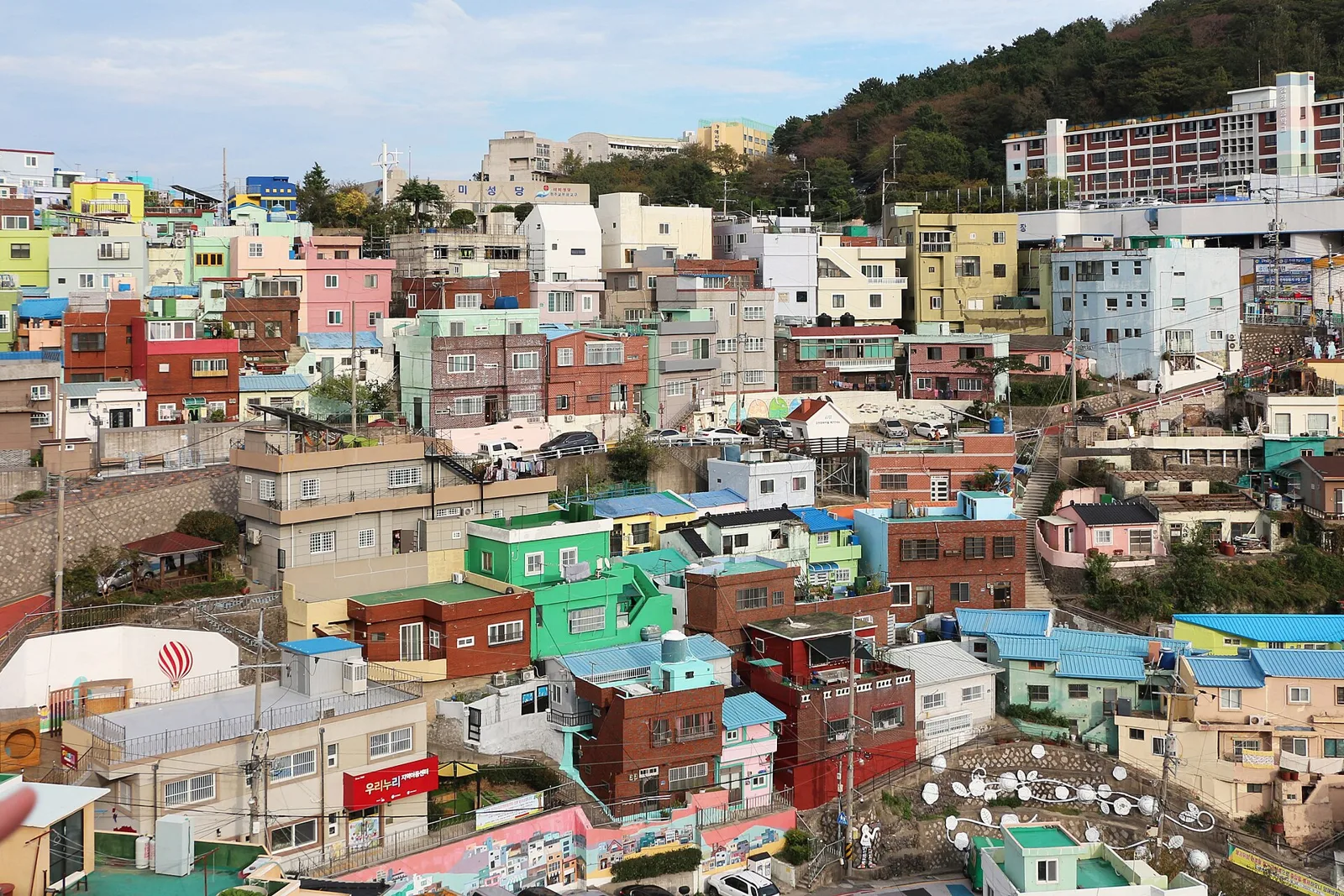
Our full Gamcheon Culture Village guide has the stamp route, the best viewpoints and how to pair Gamcheon with Huinnyeoul village.
Afternoon: BIFF Square, Gukje Market and Jagalchi
Take a village bus back down to Toseong and ride Line 1 one stop to Jagalchi (자갈치역), or take a taxi straight to Nampo. Three sights sit within a 10-minute walk of each other:
- BIFF Square (BIFF광장): the street where the Busan International Film Festival began, with handprints of film stars in the pavement. It is the place to try ssiat hotteok (씨앗호떡), a fried pancake filled with brown sugar and stuffed with seeds and nuts, Busan’s best-known street snack. Buy one from a stall with a line.
- Gukje Market (국제시장): a maze of covered market lanes selling everything from kitchenware to clothes, born as a wartime black market. Stalls keep their own hours and some close on Sundays, so go on a weekday afternoon if you can.
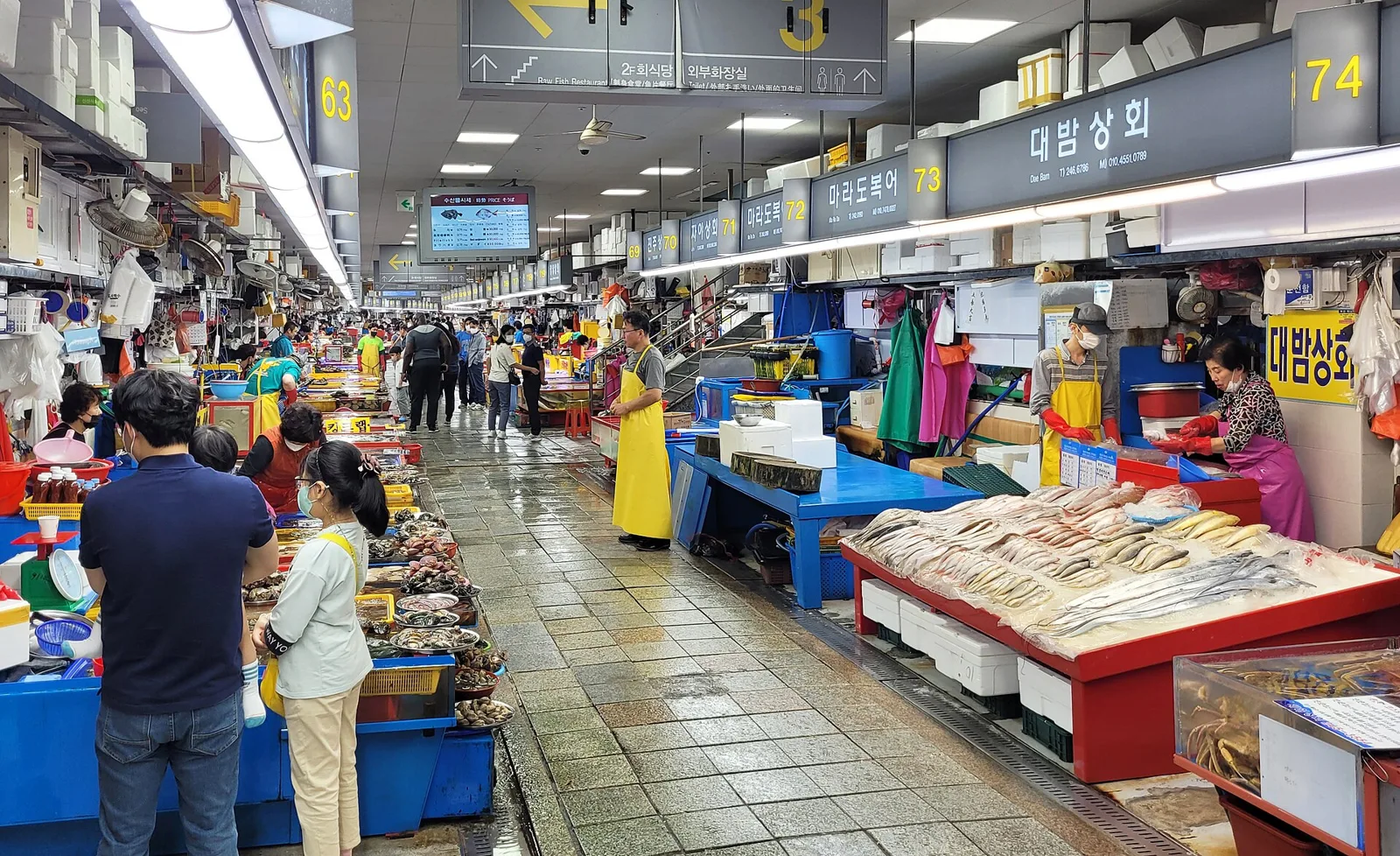
- Jagalchi Market (자갈치시장): Korea’s most famous fish market, on the harbor. Walk the ground floor to see the live tanks, then, if you want a seafood meal, buy fish downstairs and have it prepared at a restaurant upstairs, or simply eat at one of the grilled-fish restaurants in the lanes behind. The market is generally open 5 am–10 pm and closed on the first and third Tuesday of each month (as of Oct 2026); upstairs restaurants open later in the morning.
Map — Jagalchi Market: Google Maps · Naver Map (Naver Map is still the most reliable app for walking, bus and subway directions in Korea)

Evening: Busan Tower and Yongdusan Park
Walk up (or take the outdoor escalators from Gwangbok-ro) to Yongdusan Park, a small hilltop park with Busan Tower on top. Go around sunset for views over the harbor and the Busan Harbor Bridge. The park is free; the tower costs 12,000 KRW (~$9) for adults and is open 10 am–10 pm, last entry 9:30 pm (as of Oct 2026). Then come back down to Gwangbok-ro, the pedestrian shopping street, for dinner. Our Busan food guide covers what to order, from dwaeji gukbap (pork and rice soup) to milmyeon (Busan’s cold wheat noodles).
Map — Busan Tower: Google Maps · Naver Map (Naver Map is still the most reliable app for walking, bus and subway directions in Korea)
Day 2: Haedong Yonggungsa, Blueline Park, Haeundae and Gwangalli
Day 2 is the coast. Head east early, work back west along the shore, and finish at Gwangalli as the bridge lights up.
Early morning: Haedong Yonggungsa Temple (해동용궁사)
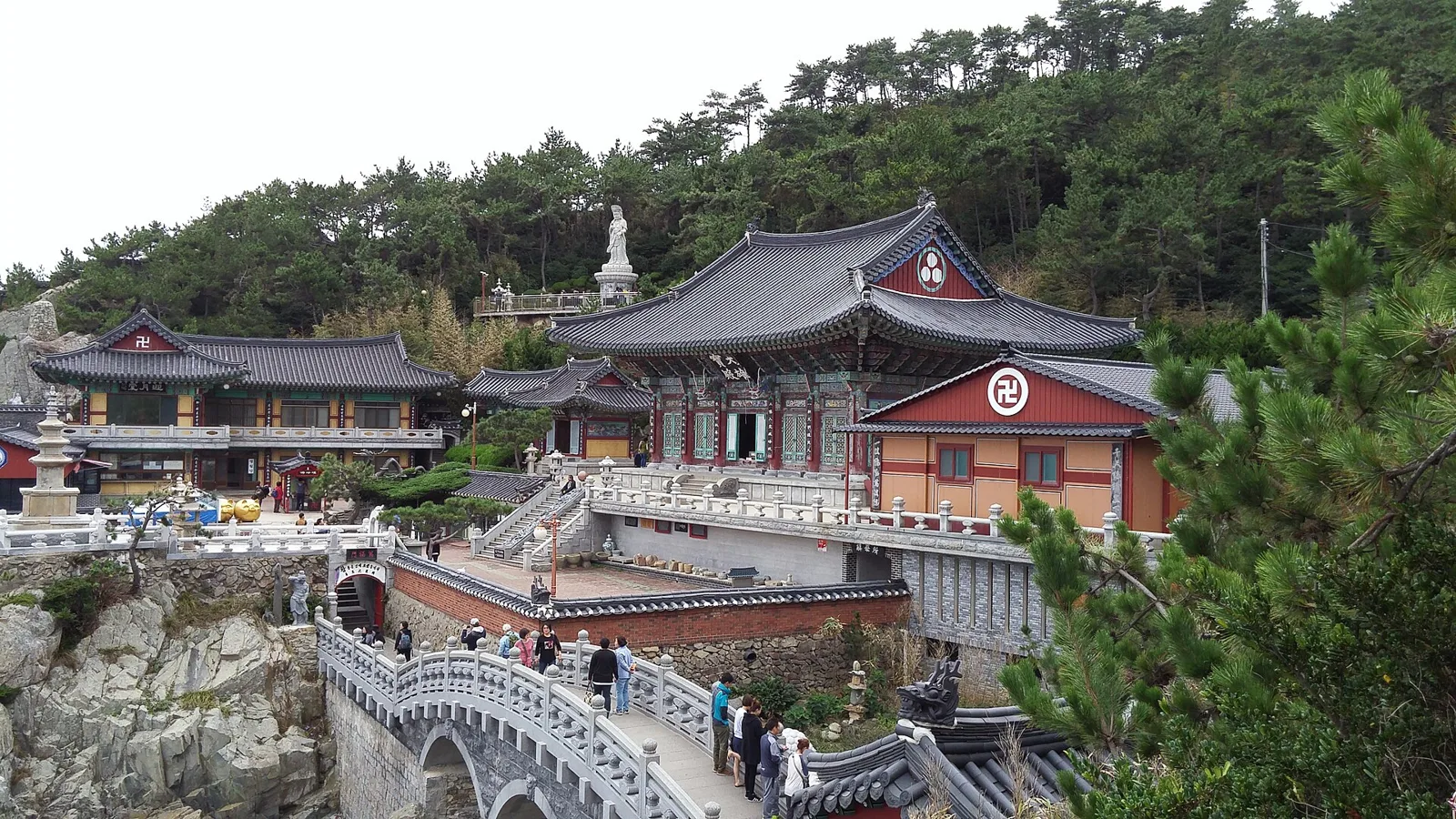
This Buddhist temple sits on rocks right above the sea, which is rare in Korea, where most temples are in the mountains. Go early: by 10 am on weekends the narrow stairway down from the entrance is shoulder to shoulder. The temple opens around dawn and closes in the early evening (listings in 2026 range from about 4:30–5 am to around 7 pm, so check before you go). Entry is free; parking is paid.
- Getting there: from Haeundae Station (Line 2), city buses such as 181 or 1001 stop at Yonggungsa Temple (용궁사) in roughly 25–30 minutes, followed by a 10–15-minute walk. Confirm the bus on Naver Map. A taxi from Haeundae takes about 20 minutes.
- Good to know: there are many steps, and it’s a working temple, so speak quietly near the halls.
Map — Haedong Yonggungsa Temple: Google Maps · Naver Map (Naver Map is still the most reliable app for walking, bus and subway directions in Korea)
Late morning: Blueline Park (Sky Capsule or Beach Train)
Haeundae Blueline Park runs along an old coastal rail line between Mipo (near Haeundae Beach) and Songjeong. There are two rides:
- Sky Capsule: small, colorful pods for 2–4 people on an elevated track between Mipo and Cheongsapo. Prices are per capsule: 50,000 KRW (~$38) for 2 people, 55,000 KRW for 3 and 60,000 KRW for 4 (official fares as of Oct 2026). It sells out on sunny weekends, so book ahead.
- Beach Train: a slow tram on the old rail line, all the way to Songjeong. A single ride costs 8,000–10,000 KRW (~$6–8) depending on the station, a two-ride ticket 14,000 KRW, and an all-day pass 16,000 KRW (as of Oct 2026). It is easier to get on than the capsule.
An efficient plan: take a taxi or bus from Yonggungsa to Cheongsapo (청사포), walk to the Daritdol Skywalk viewpoint, then ride the Sky Capsule or Beach Train back to Mipo, which leaves you at the east end of Haeundae Beach.
Book ahead (Klook / Trazy)
- Haeundae Blueline Park tickets: Sky Capsule and Beach Train vouchers in English. Sky Capsule slots on sunny weekends sell out days ahead, so book as soon as your date is fixed.
- Haedong Yonggungsa and east-coast day tour: a guided day that bundles the sea temple with other east-coast stops, handy if you would rather not juggle buses. Check what is included before you book.
- Busan city 1-day tour with Sky Capsule or yacht options (Trazy): a join-in day tour if you’d rather not plan Day 2 yourself; compare the route options on the listing.
Map — Blueline Park Cheongsapo Station: Google Maps · Naver Map (Naver Map is still the most reliable app for walking, bus and subway directions in Korea)
Afternoon: Haeundae Beach and Dongbaek Island
Walk the length of Haeundae Beach (해운대해수욕장), Busan’s most famous beach, about 1.5 km of sand backed by hotels and towers. At the west end, follow the coastal path around Dongbaek Island (동백섬) to Nurimaru APEC House and the lighthouse viewpoint, 30–45 minutes at an easy pace. Lunch on Haeundae’s market street (Haeundae Traditional Market) or in the streets behind the beach. Our Haeundae Beach guide covers the beach, The Bay 101 and the Blueline Park in more depth.
Map — Haeundae Beach: Google Maps · Naver Map (Naver Map is still the most reliable app for walking, bus and subway directions in Korea)
Evening: Gwangalli Beach and the bridge
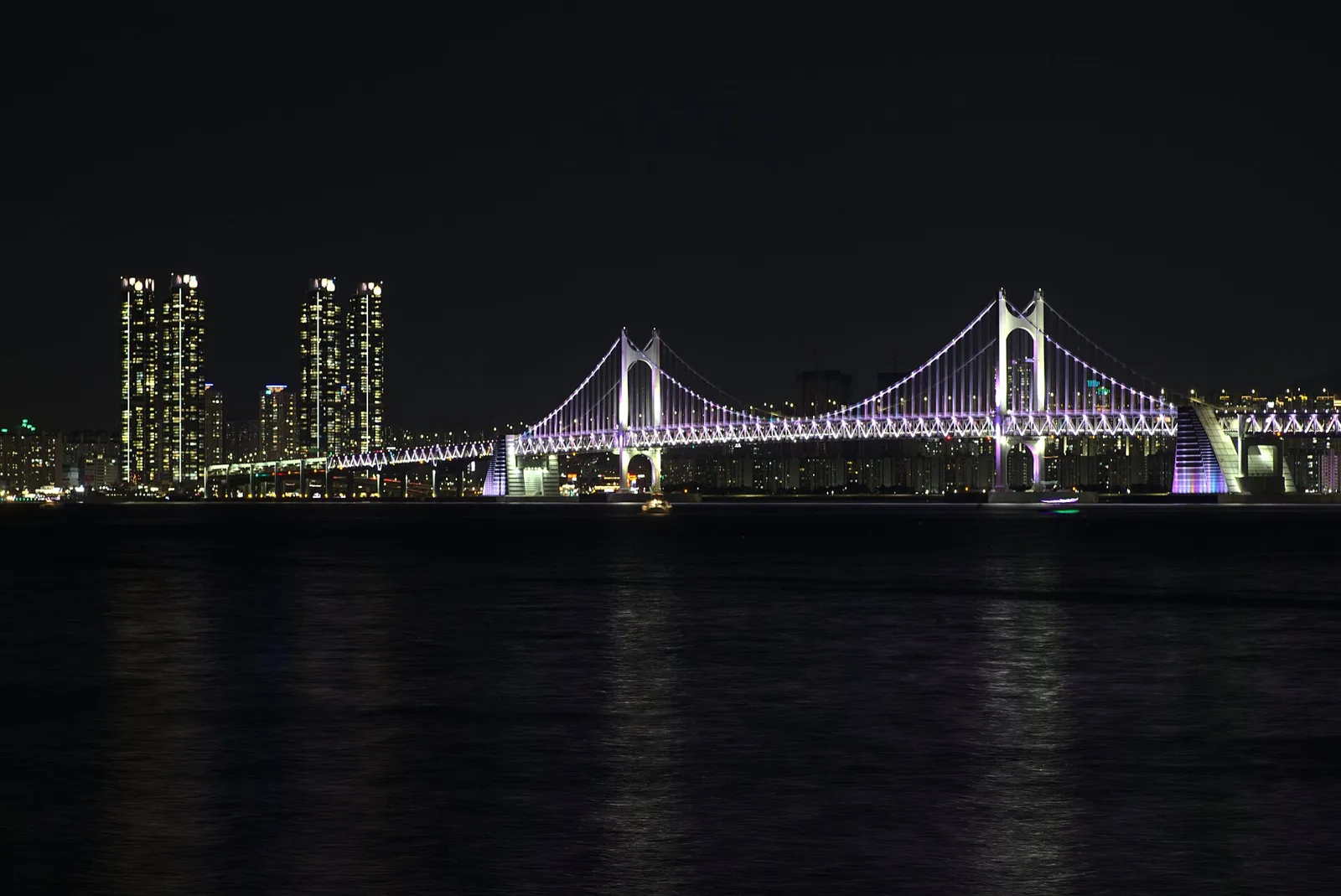
Take Line 2 west from Haeundae to Gwangan or Geumnyeonsan station (six or seven stops, about 15 minutes, then a 5–10-minute walk) for Gwangalli Beach (광안리해수욕장). Gwangan Bridge lights up after dark, and the beachfront is lined with cafés, bars and raw-fish restaurants. If you are here on a Saturday, stay for the Gwangalli drone light show: free, about 10 minutes long, at 7 pm and 9 pm from October to February and 8 pm and 10 pm from March to September (as of Oct 2026). It is cancelled in bad weather, so check the official channel on the day.
Map — Gwangalli Beach: Google Maps · Naver Map (Naver Map is still the most reliable app for walking, bus and subway directions in Korea)
Day 3: Yeongdo cliffs and Seomyeon
Day 3 crosses the bridge to Yeongdo island, a short hop from Nampo, then ends in Seomyeon, Busan’s downtown, close to Busan Station for your train home.
Morning: Huinnyeoul Culture Village (흰여울문화마을)
Huinnyeoul is a strip of small houses on a cliff above the sea, with a long walking path, murals and little cafés with ocean views. It is calmer than Gamcheon and takes about an hour. City buses from Nampo Station (Line 1, Exit 6) cross the bridge to Yeongdo in about 15 minutes; check the current route on Naver Map. Entry is free. The coastal path at the bottom (Jeollyeong coastal walk) has a short tunnel that’s a favorite photo spot. If you don’t have a bag drop at your hotel, our Busan transportation guide covers lockers at Busan Station.
Map — Huinnyeoul Culture Village: Google Maps · Naver Map (Naver Map is still the most reliable app for walking, bus and subway directions in Korea)
Late morning: Taejongdae (태종대)
At the southern tip of Yeongdo, Taejongdae is a park of pine forest and sea cliffs, with a lighthouse and an observatory. A road loop of about 4 km circles the park, and a small road train (the Danubi train) runs around it if you don’t want to walk; check the current fare and hours at the entrance. Allow two hours. Skip it if you are short on time or energy and go straight to Seomyeon.
Map — Taejongdae: Google Maps · Naver Map (Naver Map is still the most reliable app for walking, bus and subway directions in Korea)
Afternoon and evening: Seomyeon (서면)
Seomyeon, where Lines 1 and 2 meet, is Busan’s busiest shopping and eating district: an underground shopping arcade, department stores, and lanes of restaurants. It’s a good place for a last meal of dwaeji gukbap, and it’s about 15 minutes on Line 1 to Busan Station for the KTX. If you have time, the cafés of the Jeonpo Café Street (전포카페거리) are a short walk away.
Map — Seomyeon Station: Google Maps · Naver Map (Naver Map is still the most reliable app for walking, bus and subway directions in Korea)
2 days in Busan
With two days, keep Days 1 and 2 as they are and drop Yeongdo. If you are arriving late on Day 1, swap the order: Haeundae and Gwangalli first (they are lively at night), then Gamcheon and Nampo on Day 2, finishing near Busan Station for your train.
4 days in Busan
A fourth day lets you slow down. Pick one:
- A beach morning: a lazy breakfast in Haeundae, then a walk on the Beach Train to Songjeong Beach, the quieter surfing beach at the end of the line.
- Songdo: the Songdo Marine Cable Car crosses a bay west of Nampo. The Air Cruise cabin has been listed at 15,000 KRW (~$11) round trip for adults; check the current price on the official site.
- A day trip to Gyeongju: the ancient Silla capital is a short train ride from Busan, with royal tombs, Bulguksa temple and a pretty old town. Check train times on Korail before you go.
Busan itinerary tips
- Mind the hills: Gamcheon, Huinnyeoul and Yongdusan involve stairs and steep lanes. Wear good shoes, and see our Korea packing list.
- Taxis are cheap for short hops: for groups of three or four, a taxi is often faster than the bus between Nampo, Gamcheon and Yeongdo. Kakao T works in Busan; see our Korea travel apps guide.
- Payment: cards work almost everywhere, but market stalls and street snacks are easier with cash. See money in Korea.
Accessibility: strollers and wheelchairs
- Easiest: Haeundae and Gwangalli beachfront promenades are flat and paved, and the Busan subway has elevators at most stations.
- Harder: Gamcheon is built on a steep hill with stairs and narrow lanes; stick to the main street along the top, which is mostly level. Huinnyeoul and Haedong Yonggungsa involve many steps. Taejongdae’s road loop is paved but hilly, and the Danubi train is the easier way around.
- The Beach Train is the more accessible Blueline Park ride; ask staff about boarding with a wheelchair or stroller before you buy.
Nearby on Korea Bestie
- Where to stay in Busan — Haeundae vs Gwangalli vs Seomyeon vs Nampo
- Gamcheon Culture Village guide — stamp map, viewpoints and getting there
- Haeundae Beach guide — Blueline Park, Dongbaek Island and more
- Busan food guide — what to eat and where
- Busan transportation guide — airport, subway, buses and taxis
- Seoul to Busan by KTX — tickets and stations
How much will this trip cost?
Pick your group, nights, hotel type and food style — get a realistic budget range in seconds.
FAQ
How many days do you need in Busan?
Three days covers the highlights on both sides of the city without rushing. Two days is enough for Gamcheon, Nampo, Haeundae and Gwangalli; add a fourth for a day trip or a slower pace.
Is it better to stay in Haeundae or Nampo?
Haeundae if you want the beach and a resort feel; Nampo or Busan Station if you are on a short trip or catching an early train. Seomyeon sits in the middle. See where to stay in Busan.
How long does it take to get from Haeundae to Nampo?
Allow 50–60 minutes by subway (Line 2 to Seomyeon, then Line 1), or around 30–40 minutes by taxi outside rush hour.
When is the Gwangalli drone show?
On Saturday evenings: 7 pm and 9 pm from October to February, 8 pm and 10 pm from March to September (as of Oct 2026). It can be cancelled for weather.
Is Busan worth visiting after Seoul?
Yes. Busan feels very different: beaches, seafood and hillside villages instead of palaces. It’s about 2.5 hours from Seoul by KTX, and many travelers pair it with our Seoul itinerary.
Sources: Kyunghyang Shinmun – Busan foreign visitors, first half of 2026 (Aug 2026) · Visit Busan – Gamcheon Culture Village · Haeundae Blueline Park – fares · Busan Metropolitan City – Gwangalli drone light show · Busan Metropolitan City – Gamcheon Culture Village Alley Festival 2026 · Creatrip – Busan subway fares (2026) · Korea To Do – Jagalchi Market hours · Busan Geopark – Songdo cable car fares · MileAsia – Haedong Yonggungsa visitor guide (2026)
Photos: Jeena Paradies / Wikimedia Commons, Public domain · Bernard Gagnon / Wikimedia Commons, CC0 · Bernard Gagnon / Wikimedia Commons, CC0 · Hankook12 / Wikimedia Commons, CC0 · Christian Bolz / Wikimedia Commons, CC BY-SA 4.0
RELATED POSTS
View all

2 Days in Seoul (2026): A Perfect 2-Day Itinerary With Maps for First-Timers
October 28, 2026 | by Korea Bestie
Busan in Winter (2026–27): Weather, Light Festivals and What to Do December to February
October 28, 2026 | by Korea Bestie
Hongdae at Night (2026): A 6-Hour Evening Route With Map
October 26, 2026 | by Korea Bestie